
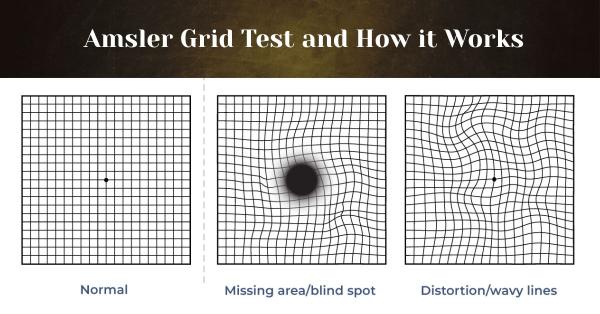
Amsler Grid Test and How it Works
Published On: 26/Jan/2026Table of Contents
- • Why Monitoring Central Vision Is Important
- • What Is the Amsler Grid Test?
- • What Eye Conditions Can the Amsler Grid Test Detect?
- • How Does the Amsler Grid Test Work?
- • How Is the Amsler Grid Test Performed?
- • Can the Amsler Grid Test Be Done at Home?
- • How to Interpret Amsler Grid Test Results
- • Advantages of the Amsler Grid Test
- • Limitations of the Amsler Grid Test
- • Amsler Grid Test vs Other Macular Tests
- • Who Should Take the Amsler Grid Test?
The Amsler Grid Test is a straightforward screening method for evaluating central vision, which is in charge of sharp and detailed vision. It involves focusing on a central dot while looking at a grid of straight lines to identify any distortion, blurring, or missing areas. Changes in the grid can reveal early issues affecting the macula and central vision, necessitating additional eye examination.
Why Monitoring Central Vision Is Important
Monitoring central vision is vital because it provides the clear, detailed vision needed for daily tasks including reading, facial recognition, driving, and using digital devices. Macular diseases like age-related macular degeneration, which can appear as blurriness, distortion, or dark spots in the center of the visual field, frequently start with early abnormalities in central vision. Simple vision screening tests backed by basic eye test equipment during routine checkups are essential for early detection to protect long-term eye health because they can detect minor changes before significant vision loss occurs and allow for rapid referral, diagnosis, and treatment.
What Is the Amsler Grid Test?
The integrity of central vision, which is essential for tasks requiring crisp, detailed sight like reading, identifying faces, and driving, can be evaluated using the simple yet very effective Amsler Grid Test. With a central fixation point and a straightforward square grid of horizontal and vertical lines, it enables people to keep an eye out for any distortions, waviness, missing sections, or dark spots that might show up when focused on the center. The test was created in the middle of the 20th century by Swiss ophthalmologist Marc Amsler to help identify tiny changes in the central visual field that would not be apparent in normal vision in order to help detect early indicators of macular disorders, namely age-related macular degeneration (AMD). It is a frequently used instrument in eye care, both in clinical settings and for home monitoring, due to its simplicity, convenience of use, and non-invasiveness. This allows for early identification of macular and retinal disorders, quick intervention, and continuous tracking of central vision health throughout time.
What Eye Conditions Can the Amsler Grid Test Detect?
The main purpose of the Amsler Grid Test is to identify disorders that impact the macula, the center region of the retina that is in charge of detailed vision. It is particularly useful in detecting early indicators of age-related macular degeneration (AMD), when central visual abnormalities or blind patches may initially manifest. The test can also detect diabetic maculopathy, a consequence of diabetes that affects the macula, and macular edema, which results in swelling and distortion of vision. It can also be used to identify other macular conditions that affect the central visual field, such as central serous retinopathy, a condition where fluid builds up beneath the retina. The Amsler Grid Test enables early diagnosis and immediate referral for additional assessment and treatment by revealing minute variations in the appearance of straight lines or whether parts of the grid are missing or distorted.
How Does the Amsler Grid Test Work?
The Amsler Grid Test assesses central vision using a straightforward square grid of horizontal and vertical lines with a center fixation dot. The test involves the person focusing on the central dot while looking at the surrounding lines; any regions of the grid that are wavy, absent, blurry, or distorted suggest that the macula may not be working properly. Straight lines seem curved, fractured, or absent due to damage or irregularities in the macula that interfere with the normal mapping of light onto the retina. By closely observing these alterations, eye care specialists can spot early indicators of macular illnesses, track their development over time, and decide whether additional diagnostic procedures or therapies are required.
How Is the Amsler Grid Test Performed?
The Amsler Grid Test is carried out using a straightforward, methodical process that enables meticulous evaluation of central vision. To identify any anomalies in each eye separately, the test is first performed one eye at a time while covering the other eye. To ensure that the lines are clearly visible, the user holds the grid in a well-lit room at a comfortable reading distance, usually between 14 and 16 inches (35 and 40 cm) from the eyes. The person looks at the surrounding grid while concentrating on the central dot, noting any places where lines seem twisted, wavy, blurry, or absent. It is a rapid and non-invasive method of identifying early abnormalities in macular function. The procedure is repeated for the opposite eye, and the full test often takes only a few minutes.
Can the Amsler Grid Test Be Done at Home?
The Amsler Grid Test is a useful tool for continuous central vision monitoring since it may be easily completed at home. Home use enables people to monitor tiny changes in their vision between clinical appointments, particularly those who are more susceptible to macular disorders such diabetic maculopathy, age-related macular degeneration, or a history of retinal problems. Frequent self-testing, ideally once a week, enables immediate consultation with an eye care specialist by assisting in the early detection of new distortions, blurriness, or missing areas. For reliable findings, testing distance, lighting, and concentration on one eye at a time must be consistent. Any alterations should be quickly followed up on to guarantee early intervention and stop any advancement of macular problems.
How to Interpret Amsler Grid Test Results
Understanding Amsler Grid Observing the grid lines while concentrating on the central dot is part of the test findings. Healthy central vision is indicated by normal results, which show straight, uniformly spaced lines without any missing, wavy, blurry, or distorted areas. Signs of possible macular issues, such as age-related macular degeneration, macular edema, or other retinal abnormalities, include abnormal findings such as lines that seem twisted, broken, blurry, or parts of the grid that appear to vanish. It is extremely important to see an eye specialist right away for a thorough examination and early intervention if any distortions or changes are observed. Immediate discovery can assist stop additional vision loss and direct the right course of treatment.
Advantages of the Amsler Grid Test
As a central vision screening technique, the Amsler Grid Test has a number of benefits. It is easy to use and rapid, offering instant insights into possible macular issues without the need for drawn-out or complicated procedures. The printed or digital grid is all that is required, thus it can be used at home or in clinical settings. It is also very helpful for continuous self-monitoring, which enables people particularly those who are susceptible to diseases like diabetic maculopathy or age-related macular degeneration to track minute changes in their central vision over time and seek quick medical attention if abnormalities emerge.
Limitations of the Amsler Grid Test
The Amsler Grid Test has many limitations even though it is a useful screening tool. It cannot accurately identify or categorize macular or retinal illnesses and is not a diagnostic test in and of itself. The test cannot take the place of more sophisticated eye exams like a thorough fundus examination or Optical Coherence Tomography (OCT), which offer exact assessment of retinal health and detailed imagery. The Amsler Grid should be used as a supplementary tool in conjunction with routine professional eye exams rather than as a stand-alone technique for evaluating general eye health because it only focuses on central vision and may not identify issues affecting peripheral vision.
Amsler Grid Test vs Other Macular Tests
The goal and specifics of the Amsler Grid Test are different from those of other macular evaluations such as fundus examination and Optical Coherence Tomography (OCT). OCT delivers accurate, high-resolution imaging of the retina, enabling eye experts to identify structural alterations, swelling, or fluid accumulation that might not be apparent on the Amsler Grid, which offers a straightforward, subjective check for aberrations in central vision. Similar to this, a fundus examination makes it possible to see the retina and macula directly, which aids in determining the underlying reasons for changes in vision. Multiple tests are frequently required for a thorough examination, guaranteeing early detection, precise diagnosis, and efficient treatment of macular problems because each test offers supplementary information regarding functional versus structural assessment.
Who Should Take the Amsler Grid Test?
The Amsler Grid Test is recommended for individuals who are at higher risk of developing macular problems or who need ongoing monitoring of central vision. This includes people with risk factors for macular disease, such as a family history of age-related macular degeneration, as well as diabetic patients who may develop diabetic maculopathy. Older adults, who are more susceptible to age-related changes in the macula, can benefit from regular screening to catch early signs of degeneration. Additionally, patients already diagnosed with retinal or macular conditions should use the test routinely to track changes in vision, enabling timely follow-up and intervention when new distortions, blurriness, or blind spots appear.
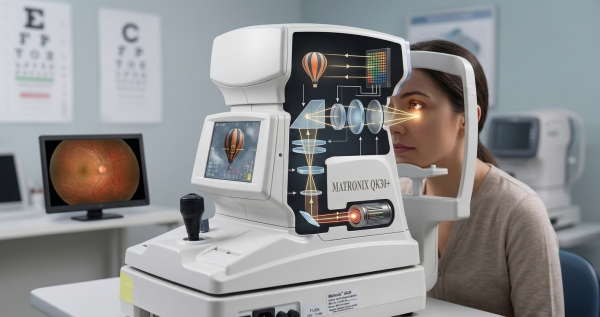
By offering a rapid, easy, and efficient method of monitoring central vision for early indicators of macular diseases, the Amsler Grid Test is important for preserving eye health. Its main advantages include the ability to identify distortions, blurriness, or missing regions in the central visual field, which may indicate conditions such as diabetic maculopathy, macular edema, or age-related macular degeneration before substantial vision loss develops. Regular use of the grid supports early diagnosis and timely consultation with an eye specialist, enabling more effective treatment of retinal disorders and appropriate clinical action. When combined with comprehensive eye examinations and modern diagnostic tools like an autorefractometer made by Matronix, individuals can actively contribute to preserving long-term eye health and safeguarding their eyesight.
Author's Bio

Mr. Rajender Gupta
(Director, Matronix Optotechnik Pvt. Ltd.)
With a vision to make advanced eye-care technology accessible across India and beyond, the Director of Matronix Optotechnik Pvt. Ltd. has been leading innovation in smart ophthalmic solutions since founding the company in 2019. Building on decades of industry experience and the global legacy of the Matronix brand since 2007, he has transformed the company into a trusted name in precision eye-testing equipment.
Related Posts


Frequently Asked Questions
For individuals with healthy vision, the Amsler Grid Test can be used occasionally as a basic screening tool. However, people at higher risk of macular conditions—such as older adults, diabetic patients, or those with a history of retinal disease should perform the test once a week. Regular monitoring helps detect early changes in central vision and allows timely consultation with an eye care professional.
If straight lines on the grid appear wavy, broken, blurred, or missing, it may indicate a problem with the macula, the part of the retina responsible for central vision. Such distortions can be early signs of conditions like age-related macular degeneration, macular edema, or diabetic maculopathy, and should be evaluated promptly by an eye specialist.
No, the Amsler Grid Test is a screening and monitoring tool, not a diagnostic test. While it is effective for identifying early changes in central vision, it cannot replace comprehensive eye examinations such as fundus evaluation or Optical Coherence Tomography (OCT), which provide detailed structural information about the retina.
Yes, the Amsler Grid Test is well-suited for home use and is commonly recommended for ongoing self-monitoring. It should be performed in good lighting, at a consistent reading distance, and one eye at a time. Any new or worsening distortions noticed during home testing should be reported to an eye care professional immediately.