
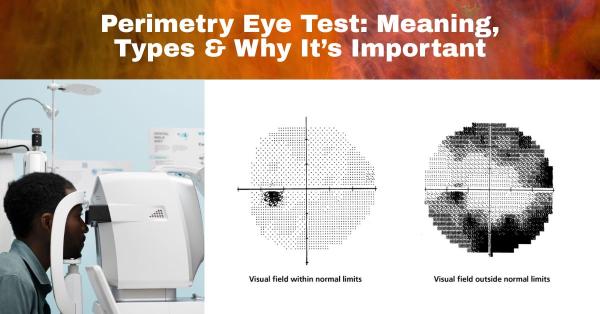
Perimetry Eye Test: Meaning, Types and Why It’s Important
Published On: 19/Mar/2026Table of Contents
One of the most important senses is vision, which keeps us safe and aware of our surroundings while enabling us to perform daily tasks like reading, driving, and identifying faces. Peripheral vision is essential for spatial awareness and balance because it enables us to perceive movement and things outside of our direct line of sight, in addition to central vision, which concentrates on tiny details. By mapping the full visual field, the Perimetry Eye Test is an essential diagnostic tool that allows for the early detection of neurological disorders and eye diseases that could otherwise go undetected.
What Is a Perimetry Eye Test?
The total region that can be seen when the eyes are fixed in one position, including both central and peripheral vision, is referred to as the visual field. A perimetry eye test is a diagnostic process used to assess a person's visual field. This test helps discover any blind spots or areas of impaired vision by measuring how receptive various sections of the visual field are to light stimulation. Perimetry is a vital tool for early diagnosis and continuous management of vision health since it is necessary in the detection and monitoring of illnesses like glaucoma, optic nerve injury, and neurological disorders.
How the Perimetry Test Works
The Perimetry Eye Test measures how well each area can perceive light stimuli that are presented at various places in the visual field. Each eye is evaluated independently while the patient sits in front of advanced eye test equipment, focuses on a central fixation target, and reacts typically by pressing a button every time a light flash appears in the periphery. The non-invasive process usually takes 5 to 10 minutes each eye, though patience and focus may be needed. In order for eye care experts to accurately identify any visual field deficits or early indicators of disease, patient cooperation is essential. Accurate and consistent responses guarantee dependable results.
Types of Perimetry Tests
Perimetry Eye Tests come in a variety of forms, each intended to evaluate the visual field in a distinct manner. Static perimetry is frequently used to detect and monitor disorders like glaucoma since it measures the eye's sensitivity to fixed spots of light at different positions. Kinetic perimetry, on the other hand, is frequently chosen for assessing more severe or widespread visual field loss since it employs moving light stimuli that move from non-seeing to seeing areas. The most used technique nowadays is automated perimetry, which uses computer-based eye test machines like the Humphrey Field Analyzer to produce accurate, consistent, and repeatable findings.
These advanced systems are commonly known as an automatic perimeter, widely used in modern ophthalmology clinics for precise visual field analysis.Last but not least, although it is less sensitive and thorough than formal perimetry tests, the Confrontation Visual Field Test is a rapid and easy screening technique that is mostly utilized in routine examinations without the need for specific equipment.
What Does Perimetry Detect?
By evaluating the entire visual field, the Perimetry Eye Test is intended to identify a variety of visual problems. It can detect blind patches, or Scotomas, that could otherwise go undetected in day-to-day life and identify peripheral vision loss. Because the test reveals minor changes in the visual field before major vision loss occurs, it is particularly useful for identifying early indicators of glaucoma. It can also reveal neurological disorders like stroke and brain tumors, which frequently result in distinctive patterns of vision loss, as well as retinal diseases that alter how light is interpreted in various parts of the eye.
Why Is the Perimetry Test Important?
The Perimetry Eye Test is important because it makes it possible to identify severe eye diseases like glaucoma early on, frequently before symptoms become apparent, allowing for immediate treatment. Additionally, it is essential for tracking how these diseases develop over time, assisting eye care specialists in determining if therapies are working or need to be modified. Perimetry helps guide precise and individualized treatment decisions by offering comprehensive insights into changes in the visual field, thereby lowering the risk of permanent vision loss and maintaining long-term eye health.
Who Should Get a Perimetry Test?
For those who are more likely to suffer visual field loss or similar disorders, a perimetry eye test is advised. This includes those who may develop glaucoma, since early identification is essential to avoiding long-term harm. Patients with systemic diseases like diabetes or hypertension, which can eventually harm the eyes, should also take note. Along with older adults who benefit from regular eye exams to track age-related changes and maintain general eye health, people with vision-related symptoms like blurred vision, trouble seeing in specific areas, or frequent eye strain should also think about this test.
Understanding Perimetry Test Results
Differentiating between normal and abnormal visual fields is necessary to comprehend Perimetry Eye Test results. A typical result displays a complete, uniformly responding field of vision, whereas abnormalities may show areas of decreased sensitivity or absent vision. Peripheral constriction, central flaws, or certain half-field losses are common patterns of visual field loss that may indicate neurological problems or illnesses like glaucoma. When such anomalies are found, more testing is frequently required to identify the underlying cause and direct the proper course of treatment, such as brain or optic nerve imaging or repeat perimetry for confirmation.
Limitations of Perimetry
The Perimetry Eye Test has several drawbacks despite being a useful diagnostic tool. The patient's replies have a significant impact on the test's accuracy, therefore things like exhaustion, inattention, or misinterpreting instructions can have an impact. Additionally, there is a learning curve effect, which could result in inconsistent results since new patients may perform less consistently until they get used to the exam. Furthermore, since a single test might not always offer a completely accurate portrayal of the visual field, repeat testing is frequently necessary to validate results and guarantee consistency.
Tips for Accurate Test Results
Patients must maintain focus during the exam and maintain eye contact with the central target, even when lights appear in the peripheral, in order to guarantee accurate results from a Perimetry Eye exam. False responses that could compromise accuracy can be avoided by closely adhering to the examiner's instructions, such as only answering when a light is actually seen. Additionally, being comfortable and well-rested both before and during the test enhances focus and lessens weariness, enabling more accurate and consistent results.
To sum up, the Perimetry Eye Test is an essential diagnostic tool for evaluating the entire visual field and identifying minute alterations in both central and peripheral vision. It is very important for quick diagnosis and efficient treatment because of its capacity to spot early indicators of diseases like glaucoma and other neurological or ocular illnesses. The preservation of vision can be greatly aided by routine eye exams that include perimetry, underscoring the significance of proactive eye care and regular monitoring for long-term eye health.
Author's Bio

Mr. Rajender Gupta
(Director, Matronix Optotechnik Pvt. Ltd.)
With a vision to make advanced eye-care technology accessible across India and beyond, the Director of Matronix Optotechnik Pvt. Ltd. has been leading innovation in smart ophthalmic solutions since founding the company in 2019. Building on decades of industry experience and the global legacy of the Matronix brand since 2007, he has transformed the company into a trusted name in precision eye-testing equipment.
Related Posts


Frequently Asked Questions
A perimetry eye test is used to measure the full visual field, including central and peripheral vision. It helps detect blind spots, vision loss, and early signs of eye conditions like glaucoma, optic nerve damage, and neurological disorders.
The test is non-invasive and usually takes about 5–10 minutes per eye. The total duration may vary depending on the type of perimetry test and the patient’s response time.
People at risk of glaucoma, individuals with diabetes or hypertension, older adults, and anyone experiencing vision problems like blurred vision or peripheral vision loss should consider getting a perimetry test.
No, the perimetry eye test is completely painless and non-invasive. It simply requires the patient to focus on a central point and respond to light stimuli during the test.