
A Simple Guide for Optometrists: How Does an Auto Refractometer Work?
Published On: 23/May/2026Table of Contents
- • What Is an Auto Refractometer?
- • The Science Behind It: How the Eye Refracts Light
- • How an Auto Refractometer Works - Step by Step
- • The Infrared Light Principle
- • The Measurement Process
- • Automated Analysis
- • Multiple Readings & Averaging
- • Step-by-Step: What Happens During a Patient Examination
- • Auto Refractometer vs Manual Refraction: Key Differences
- • Benefits of Using an Auto Refractometer in Your Clinic
- • Saves Significant Chair Time Per Patient
- • Reduces Dependency on Highly Skilled Refractionists for Initial Data
- • Useful for Non-Cooperative Patients (Elderly, Children)
- • Objective Data - No Patient Bias
- • Increases Patient Throughput in Busy Clinics and Hospitals
- • Essential for Vision Screening Camps
- • What to Look for When Buying an Auto Refractometer
- • Measurement Range (Sphere, Cylinder, Axis)
- • Auto-Tracking and Auto-Shot Capability
- • Built-In Printer vs External Output
- • Ease of Operation for Technicians
- • After-Sales Service and Warranty Support
- • Price-to-Performance Ratio for Indian Clinic Budgets
- • Conclusion
An auto refractometer, one of the most essential tools in contemporary eye care, enables the optometrist to provide a reliable estimate of the patient's prescription for glasses on a screen in less than a minute. By examining how light changes as it enters and exits the eye, an auto refractometer is a sophisticated diagnostic tool used to quantify refractive defects such myopia, hyperopia, and astigmatism. By decreasing manual labor, increasing accuracy, improving patient comfort, and facilitating quicker eye exams in clinics, hospitals, and optical shops, these devices have revolutionized contemporary optometry over time. The digital technology, automated alignment systems, and user-friendly interfaces found in today's auto refractometers enable eye care providers to provide patients of all ages with prompt and accurate results. The entire concept of auto refractometers is covered in this book, including how they operate, the various models that are on the market, their main advantages in clinical practice, and any restrictions that practitioners should be aware of in order to provide accurate diagnosis and efficient patient treatment.
What Is an Auto Refractometer?
An automated ophthalmic device called an auto refractometer is used to detect the refractive error of the eye objectively. This allows eye care providers to rapidly and reliably estimate a patient's approximate prescription for glasses without only depending on the patient's reactions. By examining how light reflects from the retina after entering the eye, the gadget determines the three primary components of a prescription: sphere (degree of nearsightedness or farsightedness), cylinder (amount of astigmatism), and axis (direction of astigmatism). The auto refractometer, which is widely used by optometrists, ophthalmologists, hospitals, optical clinics, and vision screening camps, has become a vital instrument in contemporary eye exams since it expedites the diagnostic process and increases productivity in settings with a high patient volume.The development of auto refractometers transformed optometry by offering quicker preliminary measurements, lowering human error, and making eye testing more standardized and convenient for both practitioners and patients. Prior to the advent of automated refraction technology, eye specialists mainly relied on manual trial-and-error methods using retinoscopy and trial lenses, which required more time, greater patient cooperation, and significant clinical experience.
The Science Behind It: How the Eye Refracts Light
Similar to how a camera creates an image, the cornea and crystalline lens work together to focus light onto the retina in the human eye. Myopia, hyperopia, and astigmatism are examples of refractive defects that happen when differences in the shape of the eye or the curvature of the cornea cause light to focus incorrectly on the retina. Correct prescriptions for glasses or contact lenses depend on accurate measurement of these refractive flaws. Auto refractometers instantly measure refractive values by objectively analyzing how light passes through the eye. These data provide a solid foundation for additional adjustment via subjective refraction.
How an Auto Refractometer Works - Step by Step
The Infrared Light Principle
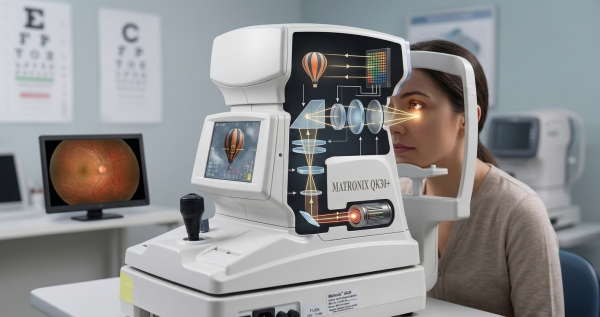
Near-infrared light, usually with a wavelength of 850 nm, is used by auto refractometers. This light is invisible and comfortable for the patient while being tested. This light is projected into the eye by the device, where it travels through the cornea and lens before bouncing back from the retina. The device swiftly and accurately determines the eye's refractive error by examining the reflected light pattern.
The Measurement Process
In order to relax and lessen the eye's natural ability to auto-focus, the patient looks at a fixation target inside the auto refractometer. This target is typically a picture, such as a home or hot air balloon, created using the "fogging" technique. After that, a number of infrared light patterns are sent into the eye by the device, and the retina reflects these patterns back through the optical system of the eye. The device can swiftly and accurately calculate sphere, cylinder, and axis values thanks to very sensitive sensors that examine variations in the reflected light patterns to ascertain the refractive condition of the eye.
Automated Analysis
The software of the auto refractometer compares the reflected light coming back from the retina with the projected infrared light patterns in order to determine how the eye is focussing light during the automated analysis stage. The technology determines the exact lens power needed to properly focus images on the retina based on these variations. The device provides a fast and accurate assessment of the patient's prescription in a matter of seconds by displaying the refractive values as spheres (S), cylinders (C), and axes (A).
Multiple Readings & Averaging
To increase accuracy and consistency, the majority of auto refractometers automatically take several readings-typically three to five measures per eye-in a matter of seconds. In order to reduce measurement inaccuracies brought on by blinking, small eye movements, or accommodation shifts, the gadget then averages these results. In addition to being quickly printed for clinical records or additional subjective refraction, the final refractive values are shown on the screen.
Step-by-Step: What Happens During a Patient Examination
- The patient is seated comfortably and has their forehead and chin properly positioned on the auto refractometer during the examination.
- In order to relax accommodation, the patient focuses on an internal target image while the technician aligns the gadget with their eye.
- The device measures refractive error by projecting infrared light into the eye and analyzing the light that is reflected from the retina.
- In a matter of seconds, modern equipment automatically aligns and takes several readings for increased precision.
- Subjective refraction is initiated by displaying and printing the final sphere, cylinder, and axis data.
Auto Refractometer vs Manual Refraction: Key Differences
An auto refractometer offers a quick and extremely accurate objective beginning point for the test rather than taking the place of manual or subjective refraction. The optometrist can expedite the refraction process and save time by using the equipment to swiftly determine the patient's refractive error. Subjective testing is still used to adjust the final prescription in order to maximize patient acceptance, comfort, and visual clarity, as seen below:
|
Feature |
Auto Refractometer |
Manual Refraction |
|
Speed |
Under 60 seconds |
15–30 minutes |
|
Operator skill needed |
Minimal |
High |
|
Patient cooperation |
Minimal |
High |
|
Accuracy |
Objective starting point |
Subjective final result |
|
Cost |
One-time equipment cost |
Ongoing chair time |
Benefits of Using an Auto Refractometer in Your Clinic
Saves Significant Chair Time Per Patient
Auto refractometers significantly shorten the time needed for initial eye examination by providing fast refractive measurements in a matter of seconds. This enables optometrists to efficiently manage more patients throughout the day and finish examinations more quickly.
Reduces Dependency on Highly Skilled Refractionists for Initial Data
The technology minimizes the need for laborious manual estimating during the first step of refraction by automatically capturing objective refractive values. This aids clinics in maintaining a steady workload while having a small number of skilled employees.
Useful for Non-Cooperative Patients (Elderly, Children)
Auto refractometers are particularly useful for patients, such as youngsters or the elderly, who may find it difficult to undergo extensive subjective testing. The rapid, non-invasive procedure increases examination convenience and necessitates less verbal response.
Objective Data - No Patient Bias
The results are unaffected by patient guesswork or inconsistent responses because the data are automatically gathered using optical analysis. This offers a trustworthy objective starting point for additional subjective improvement.
Increases Patient Throughput in Busy Clinics and Hospitals
In high-volume offices, quick automated measures facilitate clinical workflow and shorten wait times. Clinics are able to assess more patients in less time as a result of increased operational efficiency.
Essential for Vision Screening Camps
In outreach camps and large-scale vision screening initiatives, quick and portable auto refractometers are quite useful. With little setup and labor, they make it possible to quickly identify refractive defects in huge populations.
What to Look for When Buying an Auto Refractometer
Measurement Range (Sphere, Cylinder, Axis)
The device's refractive measuring range, which includes sphere, cylinder, and axis values, is one of the most needed elements. For more diagnostic flexibility and accuracy, clinics handling a wide range of refractive problems should use a model with a wide measurement range.
Auto-Tracking and Auto-Shot Capability
Auto-tracking and auto-shot capabilities on modern auto refractometers allow them to automatically align with the patient's eye and take readings without the need for manual adjustment. These features help produce more consistent measurements, speed up productivity, and lessen reliance on technicians.
Built-In Printer vs External Output
Instant printing of refractive results is made possible by an integrated thermal printer, which speeds up and improves patient documentation. Models with external output possibilities for EMR integration or connection to other diagnostic systems may also be preferred by certain clinics.
Ease of Operation for Technicians
Smooth daily clinical use requires a straightforward workflow, touchscreen controls, and an easy-to-use interface. Simple operation avoids operational errors during peak clinic hours and cuts down on technician training time.
After-Sales Service and Warranty Support
Because ophthalmic equipment needs regular maintenance, calibration, and technical assistance, dependable after-sales service is essential. Long-term performance and little downtime are ensured by selecting a manufacturer who provides installation, training, warranty coverage, and prompt servicing.
Price-to-Performance Ratio for Indian Clinic Budgets
Clinics should assess whether the device offers the ideal mix of functionality, robustness, and accuracy within their financial constraints. Long-term value is frequently higher when a machine is reliable and reasonably priced than when the cheapest choice is selected.
For clinics and hospitals throughout India, Matronix Optotechnik provides ISO-certified auto refractometers with expert installation, technician training, warranty coverage, and trustworthy after-sales service. They include models that are appropriate for high-volume eye care facilities, diagnostic centers, and small clinics.
Conclusion
In conclusion, by using infrared light technology to evaluate refractive defects quickly, objectively, and reliably, auto refractometers have become an important component of contemporary optometric practice. These devices rapidly identify sphere, cylinder, and axis values by beaming infrared light into the eye and examining the reflected light pattern from the retina. This provides an exact beginning point for additional subjective refraction. Auto refractometers greatly increase productivity, shorten examination times, and improve workflow in clinics, hospitals, and vision screening programs, but they do not take the role of an optometrist's clinical judgment and knowledge. These eye test machines continue to be essential in providing high-quality eye care thanks to developments in automation, AI-assisted measures, and user-friendly operation. Clinics wishing to improve their diagnostic capabilities can check through Matronix Optotechnik's selection of sophisticated auto refractometer models, ask for a live product demonstration, or get in touch with the sales staff for professional advice on selecting the best option for their clinic.
Author's Bio

Mr. Rajender Gupta
(Director, Matronix Optotechnik Pvt. Ltd.)
With a vision to make advanced eye-care technology accessible across India and beyond, the Director of Matronix Optotechnik Pvt. Ltd. has been leading innovation in smart ophthalmic solutions since founding the company in 2019. Building on decades of industry experience and the global legacy of the Matronix brand since 2007, he has transformed the company into a trusted name in precision eye-testing equipment.

Frequently Asked Questions
An auto refractometer is used to quickly measure a patient’s refractive error, including myopia (nearsightedness), hyperopia (farsightedness), and astigmatism. It provides an objective estimate of the eyeglass prescription before subjective refraction is performed by the optometrist.
The device projects infrared light into the eye and analyzes the reflected light from the retina. Based on how the light changes while passing through the eye’s optical system, the machine calculates sphere, cylinder, and axis values automatically within seconds.
An auto refractometer provides a highly accurate starting point for eye examinations, but the final glasses prescription is usually refined through subjective refraction performed by an optometrist to ensure maximum visual comfort and clarity.
Clinics should evaluate factors such as measurement range, auto-tracking capability, ease of use, built-in printer, after-sales service, warranty support, and overall price-to-performance ratio to choose the most suitable model for their practice.