
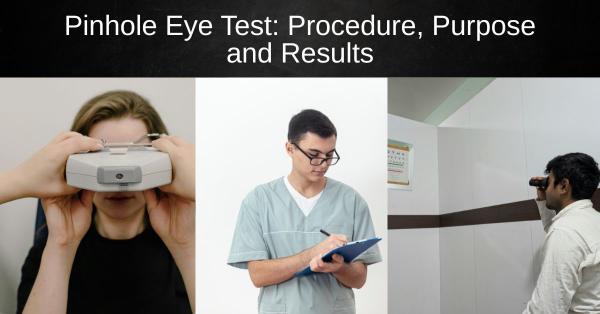
Pinhole Eye Test: Procedure, Purpose and Results
Published On: 24/Apr/2026Table of Contents
- • What is the Principle Behind the Pinhole Test?
- • When is a Pinhole Test Recommended?
- • How is the Pinhole Eye Test Performed?
- • How to Interpret Results?
- • Advantages of the Pinhole Test
- • Limitations of the Pinhole Test
- • Pinhole Test vs Modern Diagnostic Methods
- • When Should You Go for Advanced Testing?
A simple eye test technique called the pinhole eye test involves having a patient look through a tiny hole to assess their visual clarity. It assists in identifying whether refractive problems like myopia or hyperopia are the source of blurry vision. It is still utilized in modern eye tests despite advanced technology since it is quick, affordable, and offers instant diagnostic information.
What is the Principle Behind the Pinhole Test?
The pinhole test's basic idea is based on how light rays enter the eye and focus on the retina: in a normal eye, light rays are bent (refracted) to accurately converge on the retina, creating a clear image; in refractive errors, such as myopia, hyperopia, or astigmatism, light rays do not focus correctly, resulting in blur. A tiny pinhole reduces the size of the blur circle on the retina and increases depth of focus by allowing just the core, nearly parallel light rays to pass through while blocking the scattered peripheral rays. If the blur is caused by refractive error rather than an underlying eye condition, pinhole vision frequently improves since it produces a more refined image.
When is a Pinhole Test Recommended?
When a patient complains of blurred vision, a pinhole test is advised to quickly determine whether the reduced clarity is caused by a refractive error or another underlying eye condition. If vision improves when looking through the pinhole, it strongly suggests that the blur is caused by refractive issues like myopia, hyperopia, or astigmatism, whereas little or no improvement may indicate the presence of ocular pathology like cataract or retinal disease. Because the pinhole test is quick, easy, and doesn't require expensive tools.
How is the Pinhole Eye Test Performed?
A quick and easy method for evaluating visual improvement is the pinhole eye test. A standard distance between the patient and a vision chart, like the Snellen chart, is maintained while the patient is comfortably sitting. First, each eye's visual acuity is evaluated independently. Next, while the other eye is covered, a pinhole occluder is positioned in front of the eye under test. The patient is instructed to look through the pinhole and read the chart once again. Only center light beams can pass through the tiny aperture, which improves focus and lessens blur. To see if eyesight has improved, the examiner compares vision with and without the pinhole. This aids in identifying if refractive error or another ocular ailment is the cause of the problem.
How to Interpret Results?
Pinhole eye test results are simple to interpret yet have significant clinical value. It helps in distinguishing between hazy vision caused by refractive and non-refractive factors. A refractive error may be present if a patient's vision improves upon gazing through the pinhole. Astigmatism, hyperopia, and myopia are common refractive defects. Because only concentrated center light rays reach the retina, this improvement takes place. The pinhole improves visual clarity momentarily and lessens optical blur. However, the problem might not be refractive if there is little or no improvement. It might be a sign of a retinal problem or an underlying eye illness like cataracts. Beyond simple focusing problems, many conditions impact the anatomy or function of the eye. Advanced diagnostic tests are required in these situations to pinpoint the precise cause and direct treatment.
Advantages of the Pinhole Test
The pinhole test has many practical benefits that make it extremely valuable in eye care settings: it is quick and easy to perform, often taking only a few seconds to assess visual improvement, which is especially useful in busy clinics and emergency situations; it is also very cost-effective because it requires minimal resources and no expensive or sophisticated equipment just a simple pinhole occluder and a vision chart; additionally, the test does not require complex machinery or electricity, making it ideal for use in rural, remote, or low-resource environments; and despite its simplicity, it helps clinicians differentiate between refractive errors and potential eye diseases.
Limitations of the Pinhole Test
Although the pinhole test is a fast and practical screening method, it has a number of significant flaws. It cannot pinpoint the specific cause of vision issues and is not a reliable diagnostic technique. Although improvement through the pinhole indicates refractive error, it does not quantify the exact power required for repair. Detailed refraction testing is necessary for the accurate prescription of glasses or contact lenses. In situations where the patient is reluctant or has small pupils, the test may potentially produce limited or inaccurate results. Confusion may result from the gradual improvement of certain eye problems including cataracts or retinal abnormalities. For an appropriate diagnosis, the pinhole test should be considered a preliminary evaluation that is followed by thorough eye exams.
Pinhole Test vs Modern Diagnostic Methods
A straightforward manual technique for rapid vision screening is the pinhole test. It assists in determining whether a refractive defect is most likely the cause of hazy vision. It does not, however, offer accurate or comprehensive refractive power measurements. On the other hand, contemporary instruments such as the Prime 30 and K30 Auto Refractometers provide measurements that are objective. Because these devices require little patient response, the procedure is quicker and more dependable. For thorough diagnosis and exact prescriptions, they deliver reliable and accurate results. Therefore, automated equipment is favored in contemporary eye care, even though the pinhole test is helpful for preliminary evaluation.
When Should You Go for Advanced Testing?
When basic techniques, such as the pinhole test, do not considerably enhance eyesight, you should think about advanced eye testing machines. This frequently implies that the problem might not be restricted to a straightforward refractive defect. One important indicator that more testing is required is persistent hazy vision. When eye conditions such cataracts or retinal problems are suspected, further testing is often advised. A thorough investigation is also necessary for inconsistent or ambiguous visual results from basic screening. These tests aid in more accurately determining the root cause of the issue. When determining an exact prescription for glasses or contact lenses, they are important. Accurate measurements are provided by modern diagnostic equipment, guaranteeing appropriate care and improved visual results.
As a rapid, easy, and affordable screening method to determine whether blurred vision is caused by refractive error, the pinhole test is essential to primary eye care. It assists medical professionals in making quick initial decisions, particularly in settings with limited resources. However, there is a noticeable shift toward sophisticated diagnostic tools that offer exact, objective measurements for accurate diagnosis and treatment planning, making them essential for contemporary clinical practice as eye care advances toward more accuracy and thorough evaluation.
Author's Bio

Mr. Rajender Gupta
(Director, Matronix Optotechnik Pvt. Ltd.)
With a vision to make advanced eye-care technology accessible across India and beyond, the Director of Matronix Optotechnik Pvt. Ltd. has been leading innovation in smart ophthalmic solutions since founding the company in 2019. Building on decades of industry experience and the global legacy of the Matronix brand since 2007, he has transformed the company into a trusted name in precision eye-testing equipment.


Frequently Asked Questions
The pinhole eye test is a simple vision screening method where a person looks through a small hole to check visual clarity. It is used to quickly determine whether blurred vision is caused by refractive errors like myopia, hyperopia, or astigmatism.
The pinhole allows only central, focused light rays to enter the eye while blocking scattered peripheral rays. This reduces blur and increases depth of focus, often resulting in clearer vision if the issue is due to refractive error.
If vision becomes clearer when looking through a pinhole, it usually indicates that the blur is caused by a refractive error. If there is no improvement, it may suggest an underlying eye condition such as cataracts or retinal problems.
No, the pinhole test is only a preliminary screening tool. While it helps identify whether refractive error is present, it cannot determine the exact prescription or diagnose detailed eye conditions. Advanced tests are required for accurate diagnosis and treatment.