
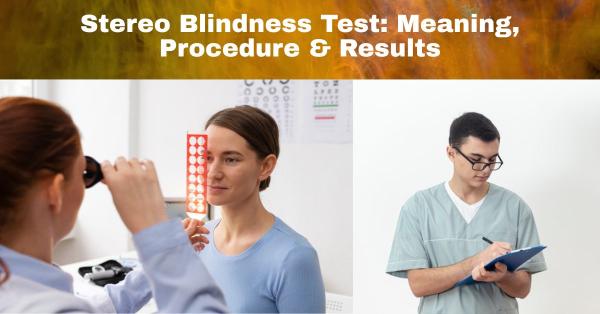
Stereo Blindness Test: Meaning, Procedure & Results
Published On: 03/Mar/2026Table of Contents
- • What Is a Stereo Blindness Test?
- • Meaning of Stereo Blindness
- • Purpose of the Stereo Blindness Test
- • Conditions Associated With Stereo Blindness
- • Types of Stereo Blindness Tests
- • Stereo Blindness Test Procedure
- • What the Stereo Blindness Test Measures
- • Understanding Stereo Blindness Test Results
- • Accuracy & Limitations of Stereo Blindness Testing
- • Stereo Blindness Test in Children vs Adults
- • Stereo Blindness Test vs Other Vision Tests
The capacity of both eyes to cooperate to produce depth perception is known as stereo vision, and it enables humans to see the world in three dimensions and make accurate distance judgments. This occurs because each eye sees objects from a slightly different perspective, and the brain integrates these images to create a single, complex, multiple image. Because diminished or missing depth perception can impair daily tasks like driving, sports, reading, and hand-eye coordination, as well as potentially reveal underlying disorders like strabismus or amblyopia, testing for stereo blindness is essential during eye exams. Children undergoing vision examinations, those with misaligned eyes, patients who report having trouble measuring distances, and those in occupations requiring accurate depth perception, like pilots, drivers, surgeons, or machine operators, are frequently advised to do a stereo blindness test.
What Is a Stereo Blindness Test?
A stereo blindness test is a visual evaluation performed to ascertain whether an individual has stereo blindness, which is the partial or total loss of depth perception brought on by improper eye coordination. When the brain is unable to successfully merge the slightly distinct images viewed by each eye into a single three-dimensional image, stereo blindness results. Stereo vision testing is used to assess binocular vision, or the ability of both eyes to coordinate, and to identify issues that could impair depth perception. The examiner can assess the patient's degree of depth perception and general binocular function by asking them to identify raised or hidden figures in particular images, patterns, or 3D shapes that are displayed, frequently utilizing polarized glasses or dot patterns.
Meaning of Stereo Blindness
A diminished or total lack of stereopsis, the brain's capacity to integrate the slightly distinct images from each eye to provide depth perception and a three-dimensional representation of the environment, is referred to as stereo blindness. Both eyes cooperate flawlessly in normal stereo vision, enabling accurate assessment of depth, distance, and spatial relationships. Stereo blindness, on the other hand, is caused by misalignment of the eyes or impaired vision in one eye, which prevents adequate binocular fusion and makes it difficult to judge depth. While complete stereo blindness results in no genuine 3D perception at all and the person primarily relies on monocular signals such size, motion, and shading to determine depth, partial stereo blindness results in limited depth awareness and may cause difficulties with fine distance estimates.
Purpose of the Stereo Blindness Test
A stereo blindness test measures how well both eyes cooperate to provide a three-dimensional image of the environment in order to gauge depth perception. It assists in identifying binocular vision impairments that might impede normal visual development and spatial judgment, such as strabismus (eye misalignment), amblyopia (lazy eye), or other coordination issues. Stereo testing is frequently used in screening programs for adults who report having trouble calculating distances or carrying out tasks requiring depth perception, as well as for children to detect vision problems early. In order to ensure maximum visual performance and long-term eye health, the results also help accurately diagnosis and direct treatment planning, whether through vision therapy, corrective lenses, or additional ophthalmic evaluation.
Conditions Associated With Stereo Blindness
Many neurological and eye disorders that impair normal binocular coordination are frequently linked to stereo blindness. The brain's ability to combine images for depth perception is hampered by strabismus, or eye misalignment, which prevents both eyes from focusing on the same location. One eye's vision is reduced by amblyopia (lazy eye), which limits stereopsis and causes the brain to rely more on the stronger eye. Depth perception and balanced visual input can both be negatively impacted by anisometropia, a large prescription disparity between two eyes. While specific neurological disorders affecting the visual pathways or brain processing centers can further impair stereoscopic vision, eye muscle imbalances may result in modest coordination issues that impede binocular fusion. When taken as a whole, these disorders emphasize how vital early identification and appropriate treatment are to maintaining or enhancing depth perception.
Types of Stereo Blindness Tests
Binocular vision and depth perception are assessed using a variety of stereo blindness tests. A popular screening method, particularly for kids, is the Titmus Fly Test, in which participants recognize elevated pictures, like a big fly or smaller animal figures, while wearing polarized glasses. The Randot Stereo Test is more accurate since it evaluates fine levels of stereopsis using random dot patterns rather than evident shape cues. The TNO Stereo Test assesses depth perception without monocular cues using random dot plates and red-green glasses. Additionally, distance stereo vision tests provide a more thorough evaluation of real-world visual function by measuring depth perception at farther viewing distances, which is essential for jobs like driving or sports. These tests are performed using specialized eye test instruments designed to accurately evaluate binocular coordination and depth perception in both children and adults.
Stereo Blindness Test Procedure
When conducting a stereo blindness test, the patient is initially seated comfortably in a well-lit, distraction-free setting, and the examiner, especially when evaluating children, explains the technique in detail. Depending on the test type, such as the Titmus Fly Test or the TNO Stereo Test, the patient is typically required to wear specialized polarized or red-green spectacles that help present slightly different pictures to each eye. The patient is then asked to detect elevated forms, hidden figures, or things that appear closer than others as the examiner displays a series of images, patterns, or dot plates. The test gradually evaluates finer levels of depth perception, one set of images at a time. It is a brief but important component of a thorough eye exam because the entire process is easy, painless, and usually takes only a few minutes.
What the Stereo Blindness Test Measures
The stereo blindness test determines how well a person perceives depth by assessing the brain's capacity to merge images from both eyes into a single three-dimensional representation. In order to determine whether the eyes are correctly aligned and cooperating to focus on the same object, it evaluates binocular coordination. Stereo acuity levels, which are often reported in seconds of arc and represent the smallest discernible depth difference a person can see, are also measured by the test. In order to help clinicians diagnose binocular vision issues and develop suitable treatment plans, lower stereo acuity levels indicate greater depth perception, whereas higher values or an inability to discern depth differences may signal diminished or absent stereopsis.
Understanding Stereo Blindness Test Results
Understanding stereo blindness test results helps determine how effectively both eyes work together to create depth perception. Normal stereo vision findings show the ability to correctly identify 3D images or depth differences at fine stereo acuity levels, typically measured in seconds of arc, with lower values indicating sharper depth perception. Reduced stereo vision results occur when a person can detect only larger depth differences, suggesting weaker binocular coordination. Stereo acuity values are interpreted by assessing the smallest disparity a patient can recognize; the smaller the number, the better the stereopsis. Abnormal results, such as very high stereo acuity values or inability to perceive depth at all, may indicate conditions like strabismus, amblyopia, anisometropia, or other binocular vision disorders that require further evaluation and possible treatment.
Accuracy & Limitations of Stereo Blindness Testing
A number of factors, such as poor patient comprehension of instructions, noncompliance (particularly in young children), uncorrected refractive errors, incorrect use of polarized glasses, and insufficient lighting during the test, can affect the accuracy of stereo blindness testing. Age is an important factor to take into account because fatigue, attention span, and cognitive ability can all have an impact on the results. While older adults may have diminished stereo acuity due to age-related vision changes, very young children may find it difficult to answer consistently. Furthermore, certain examinations might permit monocular hints, which could have a minor impact on accuracy. Due to these constraints, follow-up tests are vital to track changes over time and guarantee the diagnosis and treatment of underlying binocular vision abnormalities. Additionally, aberrant or borderline findings should be validated with repeat or alternative testing.
Stereo Blindness Test in Children vs Adults
In children, stereo blindness testing is especially essential because early identification of binocular vision issues, such as eye misalignment or unequal vision between the eyes, enables prompt treatment during years of visual development, increasing the likelihood of restoring normal depth perception. Tests are frequently made to be straightforward, interesting, and age-appropriate in order to account for behavioral variables in children, such as short attention span, shyness, difficulty understanding instructions, or inconsistent responses. Adults who suffer from disorders like eye muscle imbalance, trauma, cataracts, or neurological problems may have stereo vision loss later in life, which can have a major impact on activities like driving, sports, or work. Consequently, stereo testing is still useful for evaluating new-onset binocular vision issues in adults and directing appropriate care, even though early testing is essential for children's healthy visual development.
Stereo Blindness Test vs Other Vision Tests
In contrast to visual acuity testing, which assesses each eye's clarity or sharpness of vision independently, stereo blindness testing assesses depth awareness and how well both eyes cooperate to produce a three-dimensional image. Stereo testing especially assesses stereopsis, the brain's capacity to combine slightly distinct images from each eye into accurate depth perception, in contrast to typical binocular vision tests that concentrate on eye alignment and synchronization. Stereo testing is an essential tool for identifying and treating conditions that affect overall visual function because it can detect subtle binocular vision problems that may not affect clarity of sight but can impair distance judgment and spatial awareness. As such, it complements visual acuity and alignment tests in a comprehensive eye examination.
In conclusion, the stereo blindness test is a vital component of a thorough eye exam because it assesses binocular coordination and depth perception, both of which are critical for daily tasks including reading, driving, playing sports, and hand-eye coordination. The test promotes prompt intervention, vision correction, and appropriate treatment planning to prevent long-term visual difficulties by identifying diminished or nonexistent stereopsis early, particularly in children during critical phases of visual development. Stereo testing can assist detect new or underlying binocular vision issues that could otherwise go undetected, even in adults. Therefore, maintaining optimal visual performance and safeguarding general eye health require routine eye exams that include stereo vision evaluation.
Author's Bio

Mr. Rajender Gupta
(Director, Matronix Optotechnik Pvt. Ltd.)
With a vision to make advanced eye-care technology accessible across India and beyond, the Director of Matronix Optotechnik Pvt. Ltd. has been leading innovation in smart ophthalmic solutions since founding the company in 2019. Building on decades of industry experience and the global legacy of the Matronix brand since 2007, he has transformed the company into a trusted name in precision eye-testing equipment.
Frequently Asked Questions
A stereo blindness test is used to evaluate depth perception and binocular vision. It determines how well both eyes work together to create a three-dimensional image. The test helps detect conditions such as strabismus (eye misalignment), amblyopia (lazy eye), anisometropia, or other coordination issues that may affect accurate distance judgment.
During a stereo blindness test, the patient wears specialized polarized or red-green glasses and is shown images, patterns, or dot plates. They are asked to identify raised shapes or figures that appear closer than others. The procedure is quick, painless, and usually completed within a few minutes as part of a comprehensive eye examination.
Results are measured in seconds of arc, which indicate stereo acuity or depth perception ability. Lower values represent sharper depth perception, while higher values suggest reduced stereopsis. If a person cannot detect depth differences, it may indicate binocular vision problems that require further evaluation and treatment.
Stereo blindness testing is especially important for children because early detection of binocular vision problems improves the chances of restoring normal depth perception. Identifying issues like eye misalignment or unequal vision during critical developmental years allows timely intervention through vision therapy, corrective lenses, or further ophthalmic care.