
Corneal Pachymetry Test: Purpose, Procedure, Importance & more
Published On: 13/Aug/2026Table of Contents
- • What Is a Corneal Pachymetry Test?
- • What are the types of Corneal Pachymetry Tests?
- • Optical Pachymetry
- • Ultrasound Pachymetry
- • Why Is a Corneal Pachymetry Test Important?
- • How Is a Corneal Pachymetry Test Performed?
- • Before the Test
- • During the Test
- • Optical Pachymetry
- • Ultrasound Pachymetry
- • After the Test
- • What Do Corneal Pachymetry Test Results Mean?
- • What are the conditions Evaluated with a Corneal Pachymetry Test?
- • Glaucoma
- • Ocular Hypertension
- • Keratoconus
- • Fuchs' Endothelial Dystrophy
- • Corneal Edema
- • Corneal Hydrops
- • Corneal Trauma
- • What are the benefits of a Corneal Pachymetry Test?
- • What are the Risks and Limitations of Corneal Pachymetry?
- • Risks
- • Limitations
A non-invasive eye test called corneal pachymetry determines the cornea's thickness, which is an important factor in full eye care. This test is essential for evaluating glaucoma, planning refractive surgery, and diagnosing and treating a variety of corneal disorders.
What Is a Corneal Pachymetry Test?
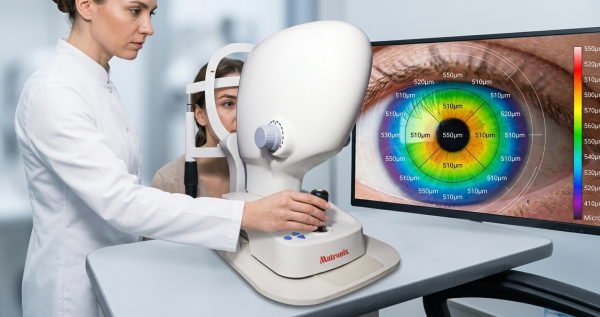
The cornea, the transparent, dome-shaped surface at the front of the eye, can be measured for thickness using a diagnostic eye test called corneal pachymetry. When evaluating conditions like glaucoma and corneal abnormalities, corneal thickness is a key measure of eye health.
Pachymetry concentrates on the cornea's thickness, in contrast to corneal topography, which maps the cornea's form and curvature. Reliable measures of corneal thickness can impact the assessment of comprehensive corneal health, the planning of refractive surgery, and the measurement of ocular pressure.
What are the types of Corneal Pachymetry Tests?
The technology utilized to evaluate corneal thickness, such as ultrasound and optical approaches, is the primary basis for categorizing corneal pachymetry examinations. Depending on the patient's requirements, the clinical environment, and the goal of the test, every type provides reliable thickness measures.
Optical Pachymetry
A non-contact technique for determining pachymetry, which makes use of modern imaging tools like Optical Coherence Tomography (OCT). It is helpful for routine eye exams, corneal assessment, and refractive surgery planning because it offers accurate and thorough measurements without requiring the probe to come into contact with the cornea.
Ultrasound Pachymetry
A contact-based method called ultrasound pachymetry measures corneal thickness using high-frequency ultrasonic pulses. Anesthetic eye drops are used prior to the test to numb the cornea so that a tiny probe can softly touch its surface and assess its thickness.
Why Is a Corneal Pachymetry Test Important?
The accuracy of intraocular pressure (IOP) readings can be impacted by corneal thickness, which makes a corneal pachymetry test vital to a glaucoma evaluation. By detecting abnormally thin or thick corneas, it also assists eye care specialists in determining if the cornea is appropriate for LASIK and other refractive procedures.
Pachymetry also aids in the diagnosis and monitoring of corneal diseases by detecting changes in corneal thickness. Repeated measurements can be used to track recovery and evaluate changes in general corneal health following eye surgery or an injury.
How Is a Corneal Pachymetry Test Performed?
A corneal pachymetry test is conducted by determining the cornea’s thickness using either a non-contact optical device or a gentle ultrasound probe after the application of anesthetic eye drops.
Before the Test
The eye care specialist examines the patient's medical and ocular history before corneal pachymetry; in order to get exact measurements, contact lenses may need to be taken out.
During the Test
Optical Pachymetry
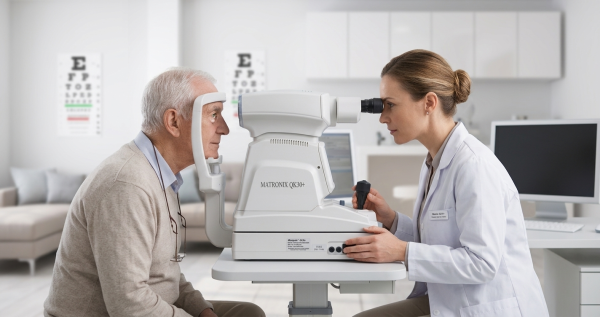
To keep their head steady, the patient presses their forehead and chin against the imaging apparatus. To obtain exact measurements of corneal thickness without touching the eye, with the help of an eye test machine, a non-contact optical scan is then carried out.
Ultrasound Pachymetry
To increase comfort, numbing eye drops are used before the treatment. A trustworthy thickness measurement can be obtained by taking repeated readings and averaging them when a handheld ultrasound probe softly contacts the cornea at predetermined spots.
After the Test
The results of corneal pachymetry are typically accessible right away and can be examined by an eye care specialist to determine corneal thickness. Further eye tests may be suggested if the results show an anomaly or call for more assessment.
What Do Corneal Pachymetry Test Results Mean?
Depending on the patient's general eye health, a thin or thick cornea may need a more thorough examination. In general, normal corneal thickness suggests a healthy corneal structure. Pachymetry results aid eye care practitioners in more properly interpreting intraocular pressure (IOP) readings, especially when assessing glaucoma, since corneal thickness can also affect IOP readings.
Age, current eye diseases, corneal health, and any prior surgeries or injuries should all be taken into consideration when interpreting the results. When planning refractive operations, corneal thickness is particularly essential since abnormally thin corneas can influence treatment choices and surgical appropriateness.
What are the conditions Evaluated with a Corneal Pachymetry Test?
Glaucoma
By measuring corneal thickness, which can affect intraocular pressure (IOP) measurements, corneal pachymetry aids in the evaluation of glaucoma. In addition to other clinical findings, this information aids eye care providers in more properly interpreting IOP and evaluating glaucoma risk.
Ocular Hypertension
When assessing increased IOP in ocular hypertension, pachymetry offers vital information on corneal thickness. The interpretation of pressure readings can be impacted by a thicker or thinner cornea, which could influence monitoring and treatment choices.
Keratoconus
Areas of irregular corneal thinning linked to keratoconus can be found using pachymetry. Corneal thickness measurements can be helpful in tracking changes over time and in evaluating the severity of the disease.
Fuchs' Endothelial Dystrophy
Reduced endothelial function in Fuchs' endothelial dystrophy may result in fluid buildup inside the cornea, increasing its thickness. These thickness variations can be measured and corneal health can be tracked with pachymetry.
Corneal Edema
Excess fluid accumulates in the cornea due to corneal edema, which frequently results in increased corneal thickness. An objective measurement that can be used to identify and track the degree of this swelling is pachymetry.
Corneal Hydrops
When fluid quickly enters the cornea thru a rip in its inner layers, it is known as corneal hydrops and is typically associated with advanced keratoconus. During evaluation and follow-up, pachymetry can be used to record changes in corneal thickness.
Corneal Trauma
Corneal thickness may alter after an eye injury due to edema, tissue damage, or changes associated with recovery. Pachymetry can promote corneal recovery monitoring and assist in quantifying these changes.
What are the benefits of a Corneal Pachymetry Test?
Corneal pachymetry is a rapid, usually painless test that provides reliable corneal thickness readings. Many patients find optical pachymetry to be a comfortable alternative because it is non-invasive and does not involve direct contact with the eye.
The test assists eye care practitioners in making accurate treatment decisions and aids the early detection and management of corneal abnormalities. Additionally, as corneal thickness can affect surgical appropriateness and planning, it is essential prior to refractive procedures like LASIK.
Because corneal thickness can influence observed intraocular pressure (IOP), pachymetry also enhances the interpretation of tonometry data. It is therefore a useful tool for glaucoma assessment and general eye care.
What are the Risks and Limitations of Corneal Pachymetry?
Risks
Optical pachymetry is a non-contact, typically well-tolerated treatment with almost no dangers. While anesthetic eye drops may infrequently produce moderate irritation or sensitivity, ultrasound pachymetry may induce mild, transient irritation or discomfort due to the probe's gentle contact with the cornea.
Limitations
Although corneal pachymetry measures corneal thickness, it is not a diagnostic tool for eye problems. The results should always be evaluated in conjunction with the patient's overall clinical findings and may need to be coupled with other procedures, such as tonometry, slit lamp examination, or corneal topography.
Corneal pachymetry is a fast, accurate, and useful eye test that assesses corneal thickness and aids in the assessment of glaucoma, corneal disorders, and the applicability of refractive surgery. It helps eye care providers make accurate diagnosis and treatment decisions by offering vital information regarding corneal health and aiding in the interpretation of IOP readings. Corneal pachymetry helps provide complete eye care and efficient monitoring of ocular health when used in conjunction with other eye exams.
Author's Bio

Mr. Rajender Gupta
(Director, Matronix Optotechnik Pvt. Ltd.)
With a vision to make advanced eye-care technology accessible across India and beyond, the Director of Matronix Optotechnik Pvt. Ltd. has been leading innovation in smart ophthalmic solutions since founding the company in 2019. Building on decades of industry experience and the global legacy of the Matronix brand since 2007, he has transformed the company into a trusted name in precision eye-testing equipment.
Related Posts

Frequently Asked Questions
A corneal pachymetry test measures the thickness of the cornea. It is commonly used during glaucoma evaluation, for assessing corneal conditions, interpreting intraocular pressure (IOP) readings, and determining suitability for refractive procedures such as LASIK.
Corneal pachymetry is generally quick and painless. Optical pachymetry is a non-contact procedure, while ultrasound pachymetry may involve mild, temporary discomfort because a small probe gently touches the cornea after numbing eye drops are applied.
Average central corneal thickness is generally around 540–550 microns, although normal values can vary between individuals. Eye care professionals consider factors such as age, eye health, previous surgery, and the measurement method when interpreting pachymetry results.
A corneal pachymetry test usually takes only a few minutes. Measurements are generally available immediately and can be reviewed by an eye care professional along with other eye examination results.