
Cylinder Eye Test: Purpose, Procedure, and Interpretation
Published On: 04/Sep/2026Table of Contents
- • What Is a Cylinder Eye Test?
- • Why Is a Cylinder Eye Test Important?
- • How Is a Cylinder Eye Test Performed?
- • Before the Test
- • During the Test
- • After the Test
- • How to Interpret Cylinder Eye Test Results
- • Normal Results
- • Low Cylinder Power
- • Moderate Cylinder Power
- • High Cylinder Power
- • What Different Axis Values Mean?
- • What are the benefits of a Cylinder Eye Test?
- • What Conditions Can a Cylinder Eye Test Detect?
- • Regular Astigmatism
- • Irregular Astigmatism
- • Corneal Astigmatism
- • Lenticular Astigmatism
- • Mixed Refractive Errors
- • What are the Risks and Limitations of a Cylinder Eye Test?
- • Risks
- • Limitations
In an eye examination, the Cylinder (CYL) value shows how much lens power is needed to correct astigmatism, which happens when the cornea or lens has an uneven curvature. An essential component of a thorough refraction test which assists in identifying and quantifying the degree of astigmatism is the cylinder eye test. To ensure clearer and more comfortable vision, it is important to know the CYL value in order to accurately prescribe glasses and contact lenses.
What Is a Cylinder Eye Test?
One part of a thorough refraction test used to identify and quantify astigmatism is the cylinder eye test. The cylindrical lens power needed to rectify the eye's uneven curvature is represented by the CYL value, and its strength is specified in a particular direction known as the axis. Cylinder (CYL) corrects astigmatism, Sphere (SPH) corrects typical refractive problems like myopia or hyperopia, and Axis determines the orientation at which the cylinder power should be applied in an eye prescription.
Why Is a Cylinder Eye Test Important?
A cylinder eye exam is useful for diagnosing astigmatism and establishing the appropriate amount of cylinder lens power required to improve vision. Accurately measuring the CYL value and axis helps improve vision clarity and sharpness while lowering visual discomfort caused by untreated astigmatism, such as eye strain, headaches, and fatigue. In order to ensure that the optical correction is appropriately tailored to the patient's refractive requirements, the test is also vital in the preparation of correct prescriptions for glasses and contact lenses.
How Is a Cylinder Eye Test Performed?
Before the Test
The eye care specialist examines the patient's vision history, symptoms, past medications, and any issues with distorted or blurry vision before the cylinder eye test. The patient's baseline vision is then established with an initial visual acuity assessment, which also determines whether more refractive testing is required.
During the Test
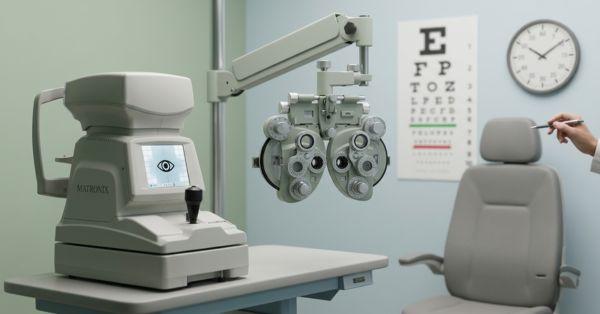
An autorefractometer may be used to perform objective refraction during the examination in order to get a preliminary assessment of the refractive power of the eye. Subjective refraction using a phoropter comes next, in which the patient evaluates various lens options to determine which one provides the best vision. Astigmatism is measured and evaluated using cylinder lenses, and the exact positioning of the cylindrical correction needed for each eye is determined by refining the axis.
After the Test
The eye care specialist examines and clarifies the sphere, cylinder, and axis values acquired during refraction following testing. To give clear and comfortable vision, the right glasses or contact lenses may be suggested based on the findings. Further examinations or diagnostic testing may also be recommended if the symptoms or results point to a potential underlying eye problem.
How to Interpret Cylinder Eye Test Results
Normal Results
When there is little to no clinically significant astigmatism, a cylinder eye test may reveal no CYL power or very little cylinder correction. In certain situations, the CYL and Axis fields may be left empty or reported as zero, and the prescription may mainly include an SPH value.
Low Cylinder Power
A mild form of astigmatism is indicated by a low cylinder power. It may result in little distortion or blurring, and corrective glasses with a low CYL value can help enhance comfort and sharpness of vision.
Moderate Cylinder Power
A more pronounced level of astigmatism that can impair vision at various distances is indicated by a moderate cylinder power. Clearer and more comfortable vision can be achieved by using the right axis in conjunction with the appropriate CYL power.
High Cylinder Power
Greater astigmatism is indicated by a high cylinder power, which may also be linked to more severe blurriness or distortion. When prescribing corrective lenses, it is very essential to determine CYL power and axis accurately.
What Different Axis Values Mean?
The Axis value, which ranges from 1° to 180° in degrees, represents the cylindrical correction's orientation. Different axis values indicate the direction in which the cylinder correction needs to be placed rather than the severity of the astigmatism.
What are the benefits of a Cylinder Eye Test?
By accurately assessing astigmatism and identifying the proper CYL power and axis for each eye, a cylinder eye exam has numerous significant advantages. With appropriately prescribed glasses or contact lenses, it offers individualized vision correction, assisting patients in achieving sharper and more comfortable vision. In addition to increasing visual comfort, correcting astigmatism may lessen symptoms like headaches, squinting, and eye strain. Accurate astigmatism correction might help some individuals see better at night by lessening distortion and blur, especially when looking at lights. By recording changes in refractive error and assisting eye care providers in determining when an updated prescription or more testing may be required, routine refraction evaluations can also enhance long-term eye care monitoring.
What Conditions Can a Cylinder Eye Test Detect?
Regular Astigmatism
When the eye has distinct focusing abilities along two major, perpendicular meridians, regular astigmatism develops. This kind of astigmatism can be detected and measured using a cylinder eye test, which also helps identify the proper CYL power and axis for vision correction.
Irregular Astigmatism
When the curvature or focusing power fluctuates unevenly throughout the cornea or lens, irregular astigmatism results. A routine refraction might show an unusual pattern, but more tests, including corneal topography, might be necessary for a thorough assessment.
Corneal Astigmatism
An uneven curvature of the cornea causes light to focus at multiple locations on the retina instead of just one, a condition known as corneal astigmatism. Cylinder testing enables proper optical correction and is useful in measuring astigmatism's refractive effect.
Lenticular Astigmatism
Instead of the cornea, lenticular astigmatism is caused by an uneven shape or optical power of the eye's natural lens. Refraction can identify how it affects vision and assist in figuring out the necessary cylinder correction.
Mixed Refractive Errors
Astigmatism that coexists with myopia or hyperopia can also be detected using a cylinder eye exam. In these situations, the astigmatism correction for a more comprehensive prescription is provided by the CYL and Axis values, while the spherical refractive error is corrected by the SPH value.
What are the Risks and Limitations of a Cylinder Eye Test?
Risks
A cylinder eye test is safe, non-invasive, and generally devoid of medical dangers because it consists solely of viewing through various lenses and reporting on visual clarity. During the testing process, some patients may suffer slight visual pain or transient eye tiredness, particularly when comparing different lens alternatives. However, these symptoms normally go away soon after the inspection.
Limitations
The cylinder eye test does not offer a comprehensive evaluation of overall eye health; instead, it assesses refractive flaws like astigmatism and is helpful in determining the proper CYL power and axis. On its own, it is unable to identify retinal, optic nerve, or other internal eye disorders. To provide a more thorough assessment of vision and eye health, it is frequently paired with tests like a slit lamp examination and retinal evaluation.
The cylinder eye test is ultimately an important part of a thorough refraction test for identifying and quantifying astigmatism as well as figuring out the proper CYL (Cylinder) power and Axis. Knowing these values enables eye care specialists to prescribe glasses and contact lenses accurately, promoting sharper, clearer, and more comfortable vision. A cylinder eye test is reliable and non-invasive, although it mainly assesses refractive problems and should be used in conjunction with other eye exams and diagnostic testing as needed. Frequent eye exams can assist track changes in vision and assure that patients receive effective and suitable vision correction.
Author's Bio

Mr. Rajender Gupta
(Director, Matronix Optotechnik Pvt. Ltd.)
With a vision to make advanced eye-care technology accessible across India and beyond, the Director of Matronix Optotechnik Pvt. Ltd. has been leading innovation in smart ophthalmic solutions since founding the company in 2019. Building on decades of industry experience and the global legacy of the Matronix brand since 2007, he has transformed the company into a trusted name in precision eye-testing equipment.
Related Posts

Frequently Asked Questions
CYL (Cylinder) indicates the amount of lens power required to correct astigmatism. It is usually accompanied by an Axis value, which indicates the direction in which the cylindrical correction should be applied.
A CYL value of 0.00 generally indicates that no cylindrical correction is required. Low CYL values indicate mild astigmatism, while higher values indicate a greater degree of cylindrical correction. The appropriate value should be determined through a comprehensive eye examination and refraction test.
No. A cylinder eye test is non-invasive and generally painless. It involves looking through different lenses and comparing which options provide clearer vision. Some people may experience temporary eye strain or fatigue during the examination.
Yes. An autorefractometer can provide an objective measurement of refractive errors, including an initial estimate of cylinder power and axis associated with astigmatism. An eye care professional may then perform subjective refraction to refine the prescription.